Should you book a political comedian?
What counts as political comedy, where the real risk sits, and how to judge whether a topical or satirical act suits your audience.
H2 link
Tell us about your event and we'll match you with the right person for your audience.
Trusted by 3k+ event planners
Recommended experts


The question of whether to book a political comedian comes up in most comedy bookings, usually late, usually from someone in legal or internal comms who's just seen the name on the running order. It deserves a real answer rather than a reflexive no.
Political comedy covers a wide range, and most of what sits under that label at corporate events carries very little risk. Some of it carries real risk, and that risk is occasionally worth taking. Knowing which is which is the whole job.
What counts as a political comedian?
Three quite different things get called political comedy, and they carry different levels of exposure. Topical comedy makes jokes about the news without arguing a position. Satire has a point of view and wants you to notice it. Comedy about class, identity and power is political in substance while rarely being party political.
Topical comedy is the lowest-risk of the three. The comic reads the week, finds the absurdity and gets out. Panel-show comics do this for a living, which is why they're a safe booking: their whole craft is being funny about current events inside someone else's format, with a producer watching.
Amy Matthews is a regular on BBC Radio Scotland's Breaking The News and writes for Have I Got News for You. She won Best Newcomer at the 2019 Scottish Comedy Awards and appeared in the BAFTA-winning Scot Squad. Lloyd Langford co-hosts The Rhod Gilbert Show on BBC Radio Wales and appears on The News Quiz, The Unbelievable Truth and QI. Both can be topical without being partisan, and both will happily pitch material at your industry's news rather than the country's.
Lloyd is also one of the few comics positioned as a panel moderator, which is useful if the political material would work better as a chaired conversation than a set. The formats sit differently, and our guide to booking a comedian, host or after-dinner speaker sets out which does what.
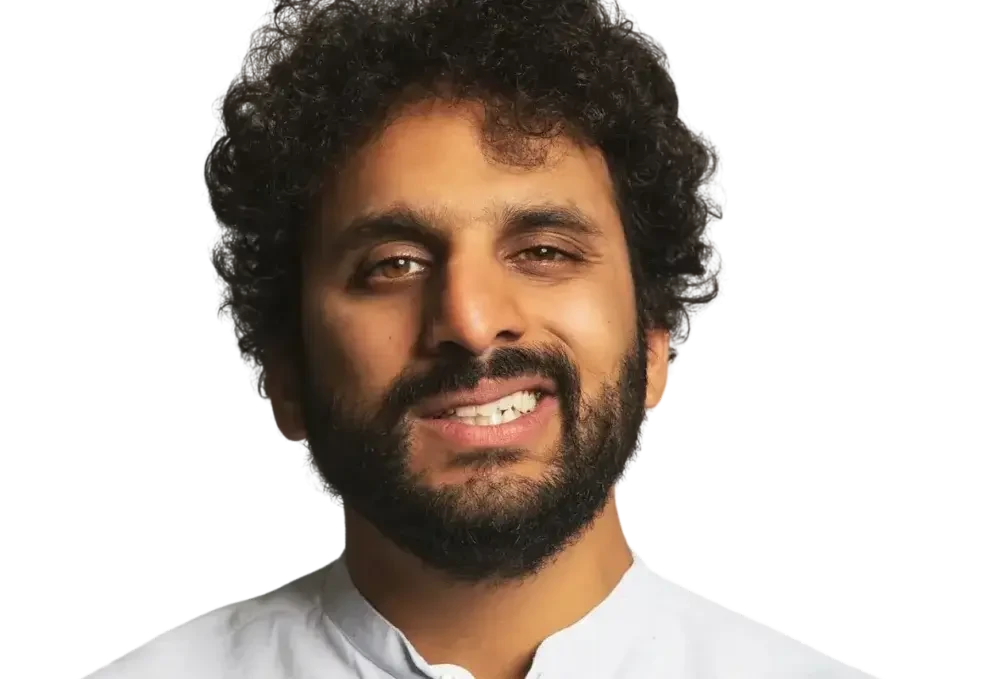
Satire has an argument in it. Nish Kumar hosted The Mash Report, co-hosts Pod Save the UK and The News Quiz, and works on climate, income inequality and the British Indian experience. David Whitney is a political satirist who also hosts, does after-dinner and works virtually, and who turns up in our piece on the comedians with a second career for reasons involving bagpipes. Nathan Caton has his own BBC Radio 4 series, Can't Tell Nathan Caton Nothing, and works across politics and social justice, having come up through Live at the Apollo, Mock the Week and Russell Howard's Good News.
Comedy about class, identity and power is the third category, and the one most likely to connect with an internal culture event. Ivo Graham makes his own Eton and Oxford background the punchline across Have I Got News for You, QI, The Last Leg and Mock the Week. Alex Haddow is a journalist who's written for The Sunday Times, The Guardian and Have I Got News for You, and won the inaugural West End Comedy Club Working Class Bursary in 2023. For a social mobility network, Alex's material does more work than a generic set.
When does political comedy work at a corporate event?
Political comedy works when your audience already shares a frame of reference. Membership bodies, trade associations, policy and public affairs teams, sustainability conferences, media organisations, charities and legal audiences all arrive with a common vocabulary about the world, so a satirist can say something sophisticated in ninety seconds without building the context first.
It also works when your event has already been serious. An agenda that's spent all day on regulatory change or restructuring has earned a comic willing to name what everybody's been thinking. The relief in a room like that is considerable, and a safe observational set won't produce it.
And it works when the comic is the draw. Nish has a following, and people come because of the point of view. Booking him and then asking him to leave the politics at home removes the reason he sells tickets.
When should you avoid booking a political comedian?
Avoid satire when your audience is politically mixed and hasn't opted in. Most large internal all-hands fall into this category: the workforce spans the full spectrum, attendance is expected rather than chosen, and the person in the next seat is a colleague they'll see on Monday. Satire needs an audience that's chosen to be there.
International audiences are the second problem. UK political comedy is dense with local reference, and a set about domestic politics will lose a room that's a third continental European and a quarter based in Singapore. It'll lose them quietly, which is worse than losing them loudly.
Client-facing events are the third. If your guests are customers being entertained on your budget, they didn't opt into a point of view, and any discomfort attaches to your brand rather than the comic's. That's usually the moment to book a topical comic instead of a satirist.
How do you brief a comedian on political material?
Ask directly rather than hinting. Comics who work corporately have this conversation constantly and won't be offended by it. Tell them the audience make-up, including how international and how politically mixed the room is, and tell them what's happened in the business recently that would make a joke land badly.
Then name your red lines specifically. "Nothing political" covers everything from no party names through to nothing about the news at all, so it tells a comic almost nothing. "Nothing about the merger, nothing about our largest client, and roughly half the room voted differently to the other half" is something they can actually work with.
Then let them do the job. A comic given a clear boundary and left alone inside it will write you something better than one being managed line by line. The people who work in this space are professionals who've been booked by banks, law firms and government departments, and none of them wants to detonate a client relationship.
So, should you book a political comedian?
For most corporate audiences, a topical comic is the right call. They give you the intelligence and the currency of political comedy with almost none of the exposure, and they'll happily aim the material at your sector rather than Westminster.
Book a satirist when you know your audience shares a frame, when the day's been heavy enough to need it, or when the point of view is the reason you want them. Those events exist, and when the match is right, that booking is remembered far longer than a safe one.
Frequently Asked Questions
Can you ask a political comedian to leave politics out of their set?
You can, and most will agree. Whether you should is a different question. If the point of view is why you wanted them, stripping it out leaves you paying a premium for a set any club comic could deliver. Book a topical comedian instead.
What's the difference between topical comedy and satire?
Topical comedy jokes about the news without taking a side. Satire argues a position and wants you to notice. Topical comics suit mixed corporate audiences; satirists suit audiences who share a frame of reference and have chosen to be in the room.
Will a comedian sign off their material in advance?
They'll discuss themes, agree exclusions and share the shape of the set. Very few will submit a full script, because corporate sets get adjusted live to the room. A clear list of exclusions protects you better than a script would anyway.
Which comedians suit an international corporate audience?
Ones whose material travels without local political reference. For a global town hall, brief away from domestic politics entirely and towards observational or workplace material, and check how much of the room is UK-based before you shortlist.
💡 Tell us your audience and we'll tell you honestly which end of the range fits, then find the perfect PepTalk expert for your organisation. Send us a message and we'll set up a free strategy call. Remember, it's always a good time to get a PepTalk!
Team PepTalk
Read more from Team PepTalk
At PepTalk, we harness the power of human intelligence to inspire and transform your people, insights, and events. Whether you're looking for expert speakers, tailored learning experiences, or unforgettable corporate events, our team is here to help. Get in touch with us today to find out more.
Tell us about your event and we'll match you with the right person for your audience.
Trusted by 5k+ event planners
Similar Articles






Tell us about your event. We'll find the right voice.
Get expert recommendations matched to your brief, your audience, and your budget.