
Available to book
Tali Sharot
Tali Sharot helps organizations understand how people make decisions, change behavior, and respond to influence. A neuroscience professor at UCL and MIT, Tali is the author of The Optimism Bias, with TED talks viewed more than 17 million times.

Tali Sharot is a cognitive neuroscientist who studies how emotion and motivation shape the way people form beliefs, make decisions, and influence one another.
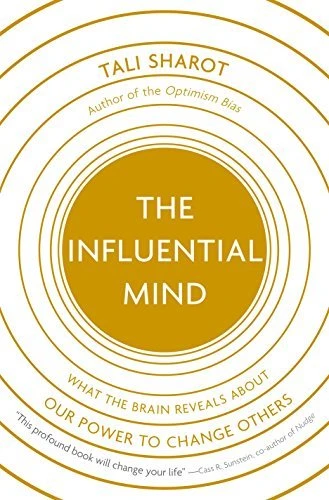
She's a professor of cognitive neuroscience at UCL and MIT, where she directs the Affective Brain Lab. Tali is the author of The Optimism Bias and The Influential Mind, both winners of the British Psychological Society Book Award, and co-author of Look Again with Cass Sunstein. Her two TED talks have been viewed more than 17 million times.
Tali has advised global companies, including Pepsi, Bank of America, and Prudential, as well as government projects, on how to encourage behavioral change. She's a former president of the Society for Neuroeconomics and has written for The New York Times, Time, and The Washington Post. Her work combines neuroscience, behavioral economics, and psychology, giving leaders an evidence base for decisions about messaging, strategy, and employee well-being.
Audiences learn why data alone rarely changes minds, and how emotion and narrative do more of the work. They see how the brain stops noticing what's constant, from a slow-building problem to something good, and how to notice it again. They also leave with practical ways to spot bias in their own decisions.
Book Tali for an evidence-led session on influence, decision-making, and behavior change, grounded in her own research.
Topics, sessions and talks
Part of our daily job is to affect others: we advise our clients, guide our patients, teach our children, and inform our online followers. Yet science shows we systematically fall into suboptimal habits when trying to change others, from insisting the other person is wrong to exerting control. Drawing on her award-winning book, The Influential Mind, Tali Sharot explains how an attempt to influence succeeds only when it's matched to the core elements that govern how we think and feel. Tali shows why data and numbers alone can be a weak approach to influence and why emotion and narrative often have a stronger impact. By understanding the minds and brains of those around us, we get better at advising and communicating information.
Change, uncertainty, and unrest have taken a toll on people's well-being. Stress, depression, and anxiety are on the rise, directly affecting physical health and productivity. What can we do at work and at home to improve the mental health of colleagues, employees, and customers? What can we do to induce happiness? Tali Sharot's answers draw on research in neuroscience, behavioral economics, and psychology. She covers the joy of anticipation and the pain of dread, why a sense of agency matters for well-being, and the perils of social comparison. Tali explains why the mind uses a 'grayscale' to perceive the world and how we might turn it off to see in color again.
Even stimulating jobs, breathtaking works of art, and exciting new gadgets lose their sparkle after a while. We desensitize to what's wonderful around us. We also stop noticing what's not so great: cracks in a relationship, a culture of fraud that developed slowly within a company, or the gradual rise of misinformation. It isn't that we're lazy or stupid. Our brains evolved to respond to what's new and different, not to things that are constant or change gradually. Drawing on Look Again, her book with Cass Sunstein, Tali Sharot shows how this leads us to miss what needs fixing and stop feeling joy in what's good, and how we can 'dishabituate' to see both clearly again.
A major goal of managers and companies is to induce behavioral change. We want to influence the actions of our clients, employees, and colleagues in positive ways. Tali Sharot has advised some of the world's largest companies, including Pepsi, Bank of America, and Prudential, on how to do exactly that. In this presentation, Tali shares which factors, according to science, have the largest impact on people's actions, and why. Using her own research, she explains how to use innate human tendencies to nudge people in the right direction and which common approaches often backfire. The audience learns practical ways to induce change and gains a deeper understanding of human behavior.
Making good decisions is key to the success of any company and a critical skill for leaders and investors. Yet making wise choices, whether about finances, business, or health, is difficult. Human decision-making is rife with bias, from overconfidence to irrational optimism and future discounting. The good news is that understanding where people go wrong lets us improve the decision-making process. Tali Sharot works at the intersection of behavioral economics, neuroscience, and psychology, turning up-to-date research in decision science into practical insight. In this lively talk, Tali helps the audience identify systematic decision-making errors and offers practical methods to correct them.
Testimonials
Featured Projects


often considered together

Beau Lotto
Science
Behavioural Science
Unconscious Bias

Mariano Sigman
Behavioural Science
Decision Making
Communication

Lynda Shaw
Behavioural Science
Leadership Development
Decision Making

frequently asked questions
Something we've not covered here?
To book Tali Sharot, email tali.sharot@getapeptalk.com or call PepTalk on +44 20 3835 2929 (UK) or +1 737 888 5112 (US), and one of our speaker agents will contact you within hours to confirm Tali's availability and speaking fee. If you can, please include your budget upfront – it helps us fast-track your request. It’s also helpful to know the date, format (virtual or in-person), location, and about your audience.
No. PepTalk adds no booking fee, so you pay the speaker's fee and nothing beyond it. The service, from shortlist through to contracts and event-day logistics, is included. For repeat or multi-event bookings, PepTalk can agree preferential rates with your procurement team.
Share your event date, audience, format, objectives and budget, and PepTalk sends a hand-picked shortlist within 24 hours. Each suggestion comes with a profile, a fee and a recommendation on the strongest fit. Once you choose, PepTalk handles contracts, travel and logistics through to event day.
The typical fee range is the speaker's standard in-person fee in their home market, shown in their local currency. It moves with format, location, date and session length: virtual sessions and shorter slots usually cost less, while international travel and peak dates cost more. Send your brief to PepTalk and the team will confirm the exact fee in your currency.
Not all of them, and it makes no difference to your booking. PepTalk's network of 15,000+ speakers covers talent the team works with directly alongside speakers represented by agents and agencies worldwide. PepTalk approaches the speaker, negotiates the fee and handles contracting either way.
Three to six months ahead is comfortable for most events, and 12 months is better for large conferences, peak-season dates or one specific in-demand speaker. Shorter timelines are workable, and PepTalk regularly fills last-minute and replacement bookings within days. Availability is the constraint, so get in touch as soon as you have a date.
Get the right person
Tell us what you’re working on and we’ll match you with the talent your audience won’t stop talking about.

